MASS MoCA is the largest center for contemporary arts in the United States.
Located in North Adams, Massachusetts this sprawling 13 acre campus of multistory 19thC. brick factory buildings is a leading-edge exhibition space of art that is currently being made in size, dimensions and techniques that defy the confinement of traditional museum gallery space.
The ten year old institution is “dedicated to the creation and presentation of provocative visual and performing arts pieces, and works that blur conventional distinctions between artistic disciplines.”
MASS MoCA also actively functions as “a laboratory for the contemporary arts, fostering experimentation by artists, encouraging collaborations among institutions, and allowing visitors a behind-the-scenes look at the creative process.”
This progressive, pro-active mission statement can not prepare the visitor for the transformational experience of being confronted by the gargantuan spaces of football length galleries, Matrix-chic industrial design and art that stops you dead in your tracks but curious to learn more.
One must commit to the intellectual participation of viewing works that are more about a concept and the process of creating an expression of that idea than simply admiring form, line and texture. It is rigorous and demanding work but unavoidably expansive.
The current exhibitions lead the visitor through rabbitholes of self-deprecating humor: “This is Killing Me” which is a group show exploring the many facets of psychodrama involved in being an artist to apocalyptic despair “These Days: Elegies for Modern Times” to Sol Lewitt’s full spectrum “Wall Drawings” that fill many galleries and explore his color theories around meticulous inkwashes and lines of grey,red,yellow,and blue.
In the lighter hearted show Sean Landers “Le’Go My Ego”(2007) is a large text based canvas covered with free- hand painted flow- charts of influences/ ideas peppered with self-sabotage. It is a hilarious exercise in grappling with an artistic temperament that is not sure about anything but “has a lot of hope for something”. I kept hearing David Sedaris’s voice reading the thought fragments as I followed the arrows around the canvas. Joe Zane’s hilarious group of works on ambition and failure offers “I wished I was a Giant” (2006), a glass vitrine lined with meticulously reproduced art magazines, Artforum etc.with him on the cover or opened to articles on his contributions to seminal art historical texts. Lampooning this quest for fame and favorable reviews the vitrine is coated with thick brown dust where mindless graffiti has been scrawled by a public that could care less.
So much to enjoy in this show and to confront in the Elegies.
In Elegies, large format videos create walls of screens and a huge cyclorama features Pawel Wojtasik’s “Below Sea Level”. It surrounds the viewers and immerses them in a dizzying 360 panorama of New Orleans after Katrina with an amazingly liquid soundscape that mourns and celebrates the vibrancy of this special city at the same time.
Sam Taylor-Wood’s “Prelude in Air”(2005) features a powerfully built cellist passionately playing a beautifully poignant Bach prelude. We hear the lovely music and see his muscles creating it… but there is no cello….
There is so much to see and experience at this art carnival for the mind…go to http:www.massmoca.org to learn more and plan to spend the day!
Monday, August 3, 2009

Monday, July 13, 2009
Dove/O’Keeffe: Circles of Influence, A Must See Exhibition
If you find yourself in the verdant hills of the Berkshires or along the sinuous Mohawk Trail in western Massachusetts this summer, chances are the many cultural delights on offer will lead you to Williamstown.
Williamstown is an idyllic New England village of manicured lawns and crisp white architecture dominated by the lovely campus of Williams College, founded in 1793.
The Clark Institute, a short drive from the center of town, has mounted an important exhibition called Circles of Influence that features the visual conversation of two kindred spirits, Arthur Dove and Georgia O’Keefe. These rarely seen works will be on view from June 7th – September 7th, 2009.
In the early 1910’s Dove and O’Keefe began simultaneously experimenting in capturing emotional, and musical vibration in charcoal and watercolor on paper, as well as the visual vibration created by light and form. In essence they were exploring a new way of seeing and ultimately became the progenitors of Modern Art in America.
O’Keefe first learned of Dove’s work in 1914 when she was a young art student.
She was introduced to him four years later by his lifetime friend and mentor and her future husband, Alfred Stieglitz. The creative empathy exchanged between these two artists was instantaneous and lifelong. To learn more about this visit http://www.clarkart.edu
For me the strongest and most groundbreaking images were the small works on paper from 1915-1919. Dove’s "#4 Creek", (1919) which he drew mid-stream as the water rushed toward the dark forest ahead, is a masterpiece and shares true affinity with O’Keefe’s "No. 15 Special" (1916/17) a charcoal drawing of a dry canyon in Texas, that uses similar forms to describe an arid landscape. Their polarity and affinity clearly in evidence here.
As the art viewing public became more aware of Freud’s ideas around sexuality and sexual expression, Dove and O’Keefe found their imagery cast in roles of gender and blatantly sexualized. Neither artist agreed or felt comfortable with this speculation.Personal perceptions of Nature and natural forms were the impetus for their designs, and rendering them in new and abstract ways was the shared goal.
If you are unaware of the incredible shift these two created in art visualization look for their earliest work. Too bad more of O’Keefe’s “Specials” were not included. These remarkable charcoal drawings are published in Georgia O’Keefe, Some Memories of Drawings, University of New Mexico Press, 1974. They are worth seeking out, as too often only the bones, flowers and mesas are brought to mind when her name is mentioned.
While at the Clark take the time to follow the nature trails on the expansive grounds.Two of them lead up to the elegant new Stone Hill Center with galleries of exceptional contemporary Asian ceramics and traditional Japanese art called, Through the Seasons (through Oct.18th) and stunning vistas of the Taconic Range and the Green Mountains.
Wishing you happy trails wherever the summer takes you….
Williamstown is an idyllic New England village of manicured lawns and crisp white architecture dominated by the lovely campus of Williams College, founded in 1793.
The Clark Institute, a short drive from the center of town, has mounted an important exhibition called Circles of Influence that features the visual conversation of two kindred spirits, Arthur Dove and Georgia O’Keefe. These rarely seen works will be on view from June 7th – September 7th, 2009.
In the early 1910’s Dove and O’Keefe began simultaneously experimenting in capturing emotional, and musical vibration in charcoal and watercolor on paper, as well as the visual vibration created by light and form. In essence they were exploring a new way of seeing and ultimately became the progenitors of Modern Art in America.
O’Keefe first learned of Dove’s work in 1914 when she was a young art student.
She was introduced to him four years later by his lifetime friend and mentor and her future husband, Alfred Stieglitz. The creative empathy exchanged between these two artists was instantaneous and lifelong. To learn more about this visit http://www.clarkart.edu
For me the strongest and most groundbreaking images were the small works on paper from 1915-1919. Dove’s "#4 Creek", (1919) which he drew mid-stream as the water rushed toward the dark forest ahead, is a masterpiece and shares true affinity with O’Keefe’s "No. 15 Special" (1916/17) a charcoal drawing of a dry canyon in Texas, that uses similar forms to describe an arid landscape. Their polarity and affinity clearly in evidence here.
As the art viewing public became more aware of Freud’s ideas around sexuality and sexual expression, Dove and O’Keefe found their imagery cast in roles of gender and blatantly sexualized. Neither artist agreed or felt comfortable with this speculation.Personal perceptions of Nature and natural forms were the impetus for their designs, and rendering them in new and abstract ways was the shared goal.
If you are unaware of the incredible shift these two created in art visualization look for their earliest work. Too bad more of O’Keefe’s “Specials” were not included. These remarkable charcoal drawings are published in Georgia O’Keefe, Some Memories of Drawings, University of New Mexico Press, 1974. They are worth seeking out, as too often only the bones, flowers and mesas are brought to mind when her name is mentioned.
While at the Clark take the time to follow the nature trails on the expansive grounds.Two of them lead up to the elegant new Stone Hill Center with galleries of exceptional contemporary Asian ceramics and traditional Japanese art called, Through the Seasons (through Oct.18th) and stunning vistas of the Taconic Range and the Green Mountains.
Wishing you happy trails wherever the summer takes you….
Tuesday, June 9, 2009
Summer Artful Explorations
Summer is on our doorsteps with gardening,mowing and all the attendant diversions of this much loved time of the year. It has taken great discipline to get back into the studio to produce new work but somehow I have managed to have a children's book underway (inspired by the lushness of growing things) and to create new works on paper for a recent exhibition.
Luckily since the Chinese presentation last December, fascination with the visual impact of the eye as symbol, continues to inspire and challenge.
Instead of using it to represent cultural viewpoints, as we attempted in Eye to Eye, I have been exploring eye symbols that exist in Eastern and Western popular iconography to represent philosophical ideas.
In this case, the ideas of Materialism vs. Spiritualism in our current day.
As financial entities continue to topple and the West is slowly weaned from the opiate of compulsive consumerism, other parts of the world are experiencing a surge of materialistic opportunities to“ buy their dreams”.
At the same time, religions compete with all the shiny new products for the attention of the populace.
Individuals that are more in tune with spiritual pursuits try to find a balance between the two in this topsy-turvy world we all share. The spiritual adage to "be in the world but not of it" has never been more difficult.
For this conceptual exercise I selected the “All-Seeing Eye of God” from the Great Seal of the United States that embellishes the American one dollar bill to represent Materialism…that “Almighty Dollar” that expresses, albeit tongue in cheek, the will to do anything to amass large quantities of it.
And other “all-seeing eyes” are from the East… painted ones that embellish the crests of Swayambunath Stupa and Bodnath Stupa in Kathmandu,Nepal to represent the idea of Spiritualism.
I am working here in mixed media with water soluble printing ink on printmaking paper to create these images. As contemporary cultures worldwide are in such a state of flux, East and West is used just to denote the source of the imagery, not to attribute the exclusive label of spiritualism and materialism to Eastern or Western points of view.
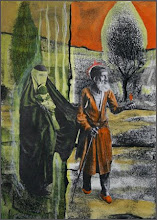
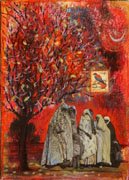
I hope you enjoy considering the philosophic overlays as they wrestle for your attention. Two recent works from this series are posted on the sidebar to the right.
If you haven't been to our blog Eye to Eye in awhile please stop by as we are always adding pictures and updates to it. There's a link on sidebar to the right. We are delighted to have visitors from all over the world.
Whereever you may be here's wishing you many pleasant diversions as the Summer Solstice approaches!
Luckily since the Chinese presentation last December, fascination with the visual impact of the eye as symbol, continues to inspire and challenge.
Instead of using it to represent cultural viewpoints, as we attempted in Eye to Eye, I have been exploring eye symbols that exist in Eastern and Western popular iconography to represent philosophical ideas.
In this case, the ideas of Materialism vs. Spiritualism in our current day.
As financial entities continue to topple and the West is slowly weaned from the opiate of compulsive consumerism, other parts of the world are experiencing a surge of materialistic opportunities to“ buy their dreams”.
At the same time, religions compete with all the shiny new products for the attention of the populace.
Individuals that are more in tune with spiritual pursuits try to find a balance between the two in this topsy-turvy world we all share. The spiritual adage to "be in the world but not of it" has never been more difficult.
For this conceptual exercise I selected the “All-Seeing Eye of God” from the Great Seal of the United States that embellishes the American one dollar bill to represent Materialism…that “Almighty Dollar” that expresses, albeit tongue in cheek, the will to do anything to amass large quantities of it.
And other “all-seeing eyes” are from the East… painted ones that embellish the crests of Swayambunath Stupa and Bodnath Stupa in Kathmandu,Nepal to represent the idea of Spiritualism.
I am working here in mixed media with water soluble printing ink on printmaking paper to create these images. As contemporary cultures worldwide are in such a state of flux, East and West is used just to denote the source of the imagery, not to attribute the exclusive label of spiritualism and materialism to Eastern or Western points of view.
I hope you enjoy considering the philosophic overlays as they wrestle for your attention. Two recent works from this series are posted on the sidebar to the right.
If you haven't been to our blog Eye to Eye in awhile please stop by as we are always adding pictures and updates to it. There's a link on sidebar to the right. We are delighted to have visitors from all over the world.
Whereever you may be here's wishing you many pleasant diversions as the Summer Solstice approaches!
Wednesday, May 6, 2009
Playing for Change: Music of Hope for Our Times
If you have yet to discover the amazing videos of musicians from around the world, singing songs of hope and inspiration from legends of Rock n Roll, R and B, Reggae and Folk traditions of the world…check this out on YouTube. http://www.youtube.com/user/playingforchange and get ready to be deeply moved and inspired by the power of music and the creative arts to transform the world.
As Mark Johnson explains on their new website www.playingforchange.com
“Playing for Change is a multimedia movement created to inspire, connect, and bring peace to the world through music. The idea for this project arose from a common belief that music has the power to break down boundaries and overcome distances between people. No matter whether people come from different geographic, political, economic, spiritual or ideological backgrounds, music has the universal power to transcend and unite us as one human race. And with this truth firmly fixed in our minds, we set out to share it with the world.”
"We built a mobile recording studio, equipped with all the same equipment used in the best studios, and traveled to wherever the music took us. As technology changed, our power demands were downsized from golf cart batteries to car batteries, and finally to laptops. Similarly, the quality with which we were able to film and document the project was gradually upgraded from a variety of formats-- each the best we could attain at the time—finally to full HD.”On YouTube and the website you can view the amazing videos produced and the singers whose heartfelt renditions inspire us all to do better personally and to be better world citizens. In this time of flux and change and economic downturn this is a much needed breath of fresh air and hope.
The good vibes continue as a Foundation was created to build music and art schools in communities needing inspiration and hope through monies raised at benefit concerts.
So do check it out, spread the message of Playing for Change and support their efforts to “connect the world through music!”.
As Mark Johnson explains on their new website www.playingforchange.com
“Playing for Change is a multimedia movement created to inspire, connect, and bring peace to the world through music. The idea for this project arose from a common belief that music has the power to break down boundaries and overcome distances between people. No matter whether people come from different geographic, political, economic, spiritual or ideological backgrounds, music has the universal power to transcend and unite us as one human race. And with this truth firmly fixed in our minds, we set out to share it with the world.”
"We built a mobile recording studio, equipped with all the same equipment used in the best studios, and traveled to wherever the music took us. As technology changed, our power demands were downsized from golf cart batteries to car batteries, and finally to laptops. Similarly, the quality with which we were able to film and document the project was gradually upgraded from a variety of formats-- each the best we could attain at the time—finally to full HD.”On YouTube and the website you can view the amazing videos produced and the singers whose heartfelt renditions inspire us all to do better personally and to be better world citizens. In this time of flux and change and economic downturn this is a much needed breath of fresh air and hope.
The good vibes continue as a Foundation was created to build music and art schools in communities needing inspiration and hope through monies raised at benefit concerts.
So do check it out, spread the message of Playing for Change and support their efforts to “connect the world through music!”.
Tuesday, April 28, 2009
Renewing the Cycles, Beginning Again
After many days of raw and cool weather, the sun has graced us once again.
The stray snowflakes that taunted us less than a week ago have been replaced by 90 degrees. It is hard to get a handle on where we are in the natural scheme of things as we scratch our heads and wonder, “Where is Spring?!” The wildlife seemingly just takes it in stride and follow their inner workings...
Only recently the warblers have been joined by Rose-breasted Grosbeaks and the greening woods echo with new birdsong each day. Early this morning I heard the dulcet tones that I eagerly await all winter to hear. A male Wood Thrush is practicing the first notes of the season. In a few days the full repertoire will performed and at early morning and early evening until late August I will be aurally transported to heaven by his recital…
The peepers keep up a steady chorus throughout the evenings now and the owls enter in from time to time with unexpected vocalizations from a nearby branch that can literally startle me awake. I laugh at the absurd and exotic calls loudly proclaimed and listen for the response from deeper in the woods.
How wonderful it is to have windows open again and to hear the stirrings of life all around. This is the reward for living in a rural area and surviving the challenges of winter in New England…. a deeply satisfying one that is worth the price in my book (though whining does occur in those last few weeks…)
The hummingbirds are yet to arrive, though last night, a raccoon helped himself to the nectar I have had waiting and tipped over the birdbath to boot.
I suspect he is the same little guy who curled up on my doormat to escape the slushy snow and sticky mud weeks ago to nap in full sun.
The uniquely eerie squeals of black bear cubs scampering after their mother were heard on the evening of April 12th, the exact date that I have recorded for the last few years.
It is comforting to note some familiar patterns in these topsy-turvy times.
Usually by the end of May I manage to get photos of these shy creatures as they check out the birdfeeders in the noonday sun. Only a few visits and they will silently disappear back into the woods.
This year even skeptical friends admitted that the enormous impressions deep in the boggy backyard could only have been made by a moose. Now that would be a sight I’d love to see…
It is hard to believe that a full turn of the year has come to pass since I started this little blog last April. The blackflies are popping faster than the daffodils at this point and who knows what the weeks ahead will delight us with.
Thanks to each of you for stopping by from time to time to see what’s happening here in the hills and here's wishing you happy sightings of the wondrous things in your own backyard!
The stray snowflakes that taunted us less than a week ago have been replaced by 90 degrees. It is hard to get a handle on where we are in the natural scheme of things as we scratch our heads and wonder, “Where is Spring?!” The wildlife seemingly just takes it in stride and follow their inner workings...
Only recently the warblers have been joined by Rose-breasted Grosbeaks and the greening woods echo with new birdsong each day. Early this morning I heard the dulcet tones that I eagerly await all winter to hear. A male Wood Thrush is practicing the first notes of the season. In a few days the full repertoire will performed and at early morning and early evening until late August I will be aurally transported to heaven by his recital…
The peepers keep up a steady chorus throughout the evenings now and the owls enter in from time to time with unexpected vocalizations from a nearby branch that can literally startle me awake. I laugh at the absurd and exotic calls loudly proclaimed and listen for the response from deeper in the woods.
How wonderful it is to have windows open again and to hear the stirrings of life all around. This is the reward for living in a rural area and surviving the challenges of winter in New England…. a deeply satisfying one that is worth the price in my book (though whining does occur in those last few weeks…)
The hummingbirds are yet to arrive, though last night, a raccoon helped himself to the nectar I have had waiting and tipped over the birdbath to boot.
I suspect he is the same little guy who curled up on my doormat to escape the slushy snow and sticky mud weeks ago to nap in full sun.
The uniquely eerie squeals of black bear cubs scampering after their mother were heard on the evening of April 12th, the exact date that I have recorded for the last few years.
It is comforting to note some familiar patterns in these topsy-turvy times.
Usually by the end of May I manage to get photos of these shy creatures as they check out the birdfeeders in the noonday sun. Only a few visits and they will silently disappear back into the woods.
This year even skeptical friends admitted that the enormous impressions deep in the boggy backyard could only have been made by a moose. Now that would be a sight I’d love to see…
It is hard to believe that a full turn of the year has come to pass since I started this little blog last April. The blackflies are popping faster than the daffodils at this point and who knows what the weeks ahead will delight us with.
Thanks to each of you for stopping by from time to time to see what’s happening here in the hills and here's wishing you happy sightings of the wondrous things in your own backyard!
Tuesday, April 14, 2009
Guggenheim Show a Feast for Eye and Mind
It seems many museums are exploring the influences of East-West dialogue this year, an idea birthed in part by the travels of Marco Polo and still topical today with the enthusiasm for late 20th and early 21st C. Asian contemporary art.
“The Third Mind: American Artists Contemplate Asia, 1860-1989”is a veritable visual circus that delights the eye and engages the mind. It creatively and most successfully illustrates how the arts, philosophy and literature of Asia, much appreciated by intellectual circles in the West in the 19th and 20th C.,inspired American artists to see and experience their world in a new way.
Upon entering the rotunda and taking in Frank Lloyd Wright’s ascending ramp that spirals up six levels you are greeted by two large cubes of ice around which eight microphones peer down like inquisitive mechanical birds. This is Paul Kos’s installation “Sound of Ice Melting” (1970) created to inspire the visitor to become a deep listener, slowing the mind to become aware of the ambient environment.
Before this can be effectively achieved, dulcet tones of bronze Tibetan cymbals ring out. Tethered by a leather cord attached to a “bell carriage”draped in flowing white silk,the ethereal vehicle gracefully descends around the inner rotunda spiral. All visitors gather along the edge to cheer it on as its random, pristine chime calls us again to clarify our minds and pay attention.
This is a remarkable site-specific piece that artist Ann Hamilton created for the show using book weights of thousands of cut-up books that are reassembled in bundles to create weights that ascend and descend with a pulley system. The title of the work is called “human carriage” (2009) and it represents the power of the transmission of ideas through books.
Books were the vehicles that relayed the Eastern ideas to creative thinkers and spiritual seekers in America for the most part.
There is a short video on the Guggenheim website in which the artist explains her concept in creating this piece, as well as a wonderful introduction and virtual tour to the exhibition by Alexandra Munroe, senior Curator of Asian Art.
From iconic work by 19th C. artists such as James McNeil Whistler, Mary Cassatt, and early 20th C. O’Keefe, Dove, Stieglitz and their circle, to mid 20th C Mark Toby, Morris Graves, Franz Kline... The list just goes on and on, as over 100 artists are represented by exceptional works.
Even the Beats are visually represented, the title actually references William S. Burroughs and Brion Gysin’s recombined cut-up manuscript called “The Third Mind”. Jack Kerouac, Ferlinghetti, and others have unexpected drawings and paintings included. This chronological order culminates on the top floor which is devoted to experimental video and minimalist works from the 1980s.
This stimulating show ends on April 19th. If you find yourself in New York City before then, run don’t walk to the Guggenheim Museum. An excellent audio guide is free with the admission of $18.00 and greatly adds to the experience.
If not, at least treat yourself to a taste of the experience by taking the virtual tour on the website www.guggenheim.org !
“The Third Mind: American Artists Contemplate Asia, 1860-1989”is a veritable visual circus that delights the eye and engages the mind. It creatively and most successfully illustrates how the arts, philosophy and literature of Asia, much appreciated by intellectual circles in the West in the 19th and 20th C.,inspired American artists to see and experience their world in a new way.
Upon entering the rotunda and taking in Frank Lloyd Wright’s ascending ramp that spirals up six levels you are greeted by two large cubes of ice around which eight microphones peer down like inquisitive mechanical birds. This is Paul Kos’s installation “Sound of Ice Melting” (1970) created to inspire the visitor to become a deep listener, slowing the mind to become aware of the ambient environment.
Before this can be effectively achieved, dulcet tones of bronze Tibetan cymbals ring out. Tethered by a leather cord attached to a “bell carriage”draped in flowing white silk,the ethereal vehicle gracefully descends around the inner rotunda spiral. All visitors gather along the edge to cheer it on as its random, pristine chime calls us again to clarify our minds and pay attention.
This is a remarkable site-specific piece that artist Ann Hamilton created for the show using book weights of thousands of cut-up books that are reassembled in bundles to create weights that ascend and descend with a pulley system. The title of the work is called “human carriage” (2009) and it represents the power of the transmission of ideas through books.
Books were the vehicles that relayed the Eastern ideas to creative thinkers and spiritual seekers in America for the most part.
There is a short video on the Guggenheim website in which the artist explains her concept in creating this piece, as well as a wonderful introduction and virtual tour to the exhibition by Alexandra Munroe, senior Curator of Asian Art.
From iconic work by 19th C. artists such as James McNeil Whistler, Mary Cassatt, and early 20th C. O’Keefe, Dove, Stieglitz and their circle, to mid 20th C Mark Toby, Morris Graves, Franz Kline... The list just goes on and on, as over 100 artists are represented by exceptional works.
Even the Beats are visually represented, the title actually references William S. Burroughs and Brion Gysin’s recombined cut-up manuscript called “The Third Mind”. Jack Kerouac, Ferlinghetti, and others have unexpected drawings and paintings included. This chronological order culminates on the top floor which is devoted to experimental video and minimalist works from the 1980s.
This stimulating show ends on April 19th. If you find yourself in New York City before then, run don’t walk to the Guggenheim Museum. An excellent audio guide is free with the admission of $18.00 and greatly adds to the experience.
If not, at least treat yourself to a taste of the experience by taking the virtual tour on the website www.guggenheim.org !
Wednesday, March 18, 2009
Signs and Symbols of Seasonal Change
Here in the wooded hills of New England, signs of Spring are arriving daily.
Sunny skies have condensed the snow pack and metal sap buckets festoon the gnarled old maple trees.
New fangled plastic tubing in aqua blue and electric purple race through the gray and white woods like a Christo installation and deliver gallons of freely flowing sap into aluminum tubs. Sugar houses have had vats continuously boiling for sometime now, producing glorious amber colored syrup, the nectar of the Yankee gods…
Our dirt road is as thick and sticky as brownie batter and if you aren’t mindful you can find yourself swerving into a quagmire or losing a boot, as it is literally sucked off your foot on your way to the mailbox. Mud season is indeed upon us.
A huge V formation of jubilantly honking geese passed overhead this morning winging their way North. This is the sign I await at every winter’s end.
Mother Nature could still throw us a curveball, as many snowstorms have manifested in late March but we all hope she retreats as a lamb. The roaring lion and sleet and wind escorted her in a most dramatic entrance.
Another change of season is at our door and the geese call us out of our dormant state to once again embrace the adventure of living…
A winter weary chorus of all living creatures answers a resounding yes…
Can you hear us?
Happy Spring to you wherever you may be!
Sunny skies have condensed the snow pack and metal sap buckets festoon the gnarled old maple trees.
New fangled plastic tubing in aqua blue and electric purple race through the gray and white woods like a Christo installation and deliver gallons of freely flowing sap into aluminum tubs. Sugar houses have had vats continuously boiling for sometime now, producing glorious amber colored syrup, the nectar of the Yankee gods…
Our dirt road is as thick and sticky as brownie batter and if you aren’t mindful you can find yourself swerving into a quagmire or losing a boot, as it is literally sucked off your foot on your way to the mailbox. Mud season is indeed upon us.
A huge V formation of jubilantly honking geese passed overhead this morning winging their way North. This is the sign I await at every winter’s end.
Mother Nature could still throw us a curveball, as many snowstorms have manifested in late March but we all hope she retreats as a lamb. The roaring lion and sleet and wind escorted her in a most dramatic entrance.
Another change of season is at our door and the geese call us out of our dormant state to once again embrace the adventure of living…
A winter weary chorus of all living creatures answers a resounding yes…
Can you hear us?
Happy Spring to you wherever you may be!
Subscribe to:
Posts (Atom)